Healthcare Practices IT Services:
IT & Cybersecurity Services for Healthcare Practices
Healthcare practices depend on reliable technology to support patient care, scheduling, communication, billing, and everyday operations. When systems become unavailable or security problems occur, the disruption can affect employees, patients, and the entire practice.
Memphis Computer Support (MCS) helps healthcare practices manage their IT environment, protect sensitive information, support employees, and prepare for technology disruptions. Our services bring together managed IT support, cybersecurity, remote support, backups, and practical technology planning.
We also help practices strengthen the technology and cybersecurity safeguards that support their broader HIPAA compliance responsibilities. Compliance involves administrative, physical, and technical safeguards, and no IT provider can guarantee compliance through technology alone.
How Prepared Is Your Practice for IT and Cybersecurity Risks?
Take the free 17-Point Technology & Cybersecurity Assessment to review important areas of your technology, security, backups, and business preparedness.
4 Big Reasons to Choose Memphis Computer Support
for Healthcare Practices IT Services
1
2
3
4

Reliable IT Support for Healthcare Practices
Healthcare employees rely on computers, networks, Microsoft 365, practice management systems, electronic health records (EHR), cloud applications, and secure communications throughout the day. When these systems are unreliable, staff may struggle to access information and complete important work.
MCS helps manage the underlying technology environment through proactive support, monitoring, user and device management, cybersecurity, backup and recovery, and technology planning. We aim to reduce avoidable interruptions and help practices maintain a secure, manageable IT environment.
Common IT Challenges for Healthcare Practices
EHR and practice management access
Clinical and administrative staff need dependable access to the applications and information used throughout the workday. MCS supports the underlying devices, networks, accounts, and connectivity, coordinating with software vendors when appropriate.
Patient information and account security
Sensitive information requires careful access management, secure devices, employee awareness, and other appropriate safeguards.
Downtime and interrupted workflows
Internet outages, hardware problems, cyber incidents, or unavailable applications can disrupt scheduling, communication, billing, and other practice operations.
Multiple vendors and connected systems
Healthcare practices may depend on EHR vendors, billing software, internet providers, printers, and other systems. Technical coordination helps reduce confusion when issues involve more than one provider.
Staff changes and access control
New hires, role changes, and departures require timely account setup, permission reviews, and removal of access that is no longer needed.
Cybersecurity and Patient Data Protection
Healthcare organizations handle sensitive patient and business information. Email accounts, employee credentials, endpoints, remote access, and cloud systems all require appropriate security protections.
MCS helps practices strengthen security around users, devices, systems, and data. Depending on the environment, this may include multifactor authentication, endpoint and email security, monitoring, patch management, vulnerability management, employee awareness, backup and recovery, and incident preparedness.
These technology safeguards can support a broader HIPAA compliance program, but the healthcare organization remains responsible for understanding and meeting its legal and regulatory obligations. Related services include cybersecurity and data backup and recovery.
Preparing for Ransomware and Technology Disruptions
Ransomware, hardware failures, compromised accounts, and other disruptions can affect access to essential systems and information. Healthcare practices should plan for prevention and recovery before an incident occurs.
A practical approach includes layered security, access controls, tested backups, recovery planning, monitoring, and documented response procedures. MCS can help evaluate these technology controls and strengthen the IT components of a practice's continuity and recovery planning.
Supporting Healthcare Employees and Technology
As a practice hires staff, adds devices, changes locations, or introduces new software, its IT needs change. MCS can assist with onboarding and offboarding, account and device management, Microsoft 365, remote IT support, security controls, monitoring, and ongoing technology management.
We can also help coordinate technical issues with practice management and EHR software vendors when problems involve networks, workstations, accounts, or other supported systems. Direct support for any particular clinical application should be confirmed before it is advertised.
Features of Our Memphis Healthcare Practices IT Support Services That Will Help Boost Productivity With Clients And Efficiency Across The Workplace
Managed IT Services
Proactive IT support, monitoring, maintenance, and technology management to help keep your healthcare practice productive and supported.
Remote IT Support
Secure remote IT support for authorized healthcare employees and supported devices, whether staff are onsite or working from another approved location.
Cybersecurity
Layered cybersecurity to help protect employee accounts, devices, systems, and sensitive practice information.
Data Backup & Recovery
Backup and recovery planning to help protect important business data and prepare for hardware failures, cyber incidents, and other disruptions.
Compliance Services
Technology and cybersecurity support for safeguards that contribute to your practice's broader compliance responsibilities.
See what other business owners are saying about us…

Why Healthcare Practices Choose MCS
By choosing Memphis Computer Support for your IT needs in healthcare practices in Memphis, you are investing in a partner dedicated to your business's success. Our commitment to fast, reliable, and professional IT support ensures that your technology works seamlessly, allowing you to focus on what you do best—serving your patients and growing your practice.Healthcare technology needs to support the people who depend on it every day. MCS takes a practical approach that connects IT support, cybersecurity, access management, backups, and vendor coordination rather than treating each issue in isolation.
We help practices review their current environment, identify technology risks, and plan improvements that fit their operations, staff, and security requirements. Our role is to support dependable technology and the technical safeguards that contribute to a broader healthcare compliance program.
Frequently Asked Questions About IT Services for Healthcare Practices
What IT services does a private medical practice need?
A private medical practice may need managed IT support, cybersecurity, Microsoft 365 management, network and device management, backup and recovery, user support, vendor coordination, and technology planning. The right mix depends on the practice's size, systems, locations, security risks, and compliance requirements.
How can a medical practice improve HIPAA cybersecurity compliance?
A practice can strengthen the technology side of its HIPAA compliance program by assessing risks, managing user access, maintaining appropriate security controls, updating systems, protecting devices and email, educating employees, and reviewing safeguards and documentation. HIPAA also includes administrative and physical requirements beyond IT.
What cybersecurity protections should a medical practice have?
Healthcare practices should review security for accounts, email, endpoints, networks, cloud systems, remote access, and sensitive data. Controls may include multifactor authentication, endpoint and email security, patching, access management, security awareness, monitoring, vulnerability management, tested backups, and incident response planning. The appropriate controls depend on the practice's risks and requirements.
How should medical practices protect patient data from ransomware?
Ransomware protection requires multiple layers. Practices should keep systems updated, secure accounts and endpoints, use multifactor authentication, limit unnecessary access, train employees, monitor for suspicious activity, and maintain tested backups and recovery procedures. An incident response plan should be in place before an attack.
What should a medical practice look for in a managed IT provider?
Look for a provider that can support everyday IT needs while understanding cybersecurity, backups, access management, vendor coordination, documentation, and the technology safeguards relevant to healthcare. Ask how support is delivered, what is included, how incidents are handled, and how the provider works with clinical software vendors and compliance resources.
Need Reliable IT and Cybersecurity Support for Your Healthcare Practice?
MCS can help your practice review its IT environment, cybersecurity, backups, employee access, and the technology safeguards that support broader compliance responsibilities.
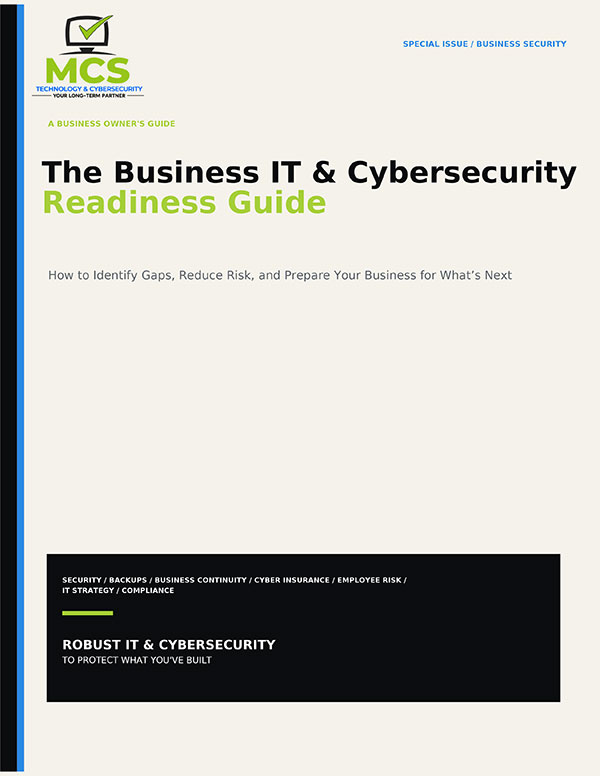
Get the Free Business IT & Cybersecurity Readiness Guide
Learn what business owners should consider when reviewing cybersecurity, backups, business continuity, employee risks, and technology preparedness.

